
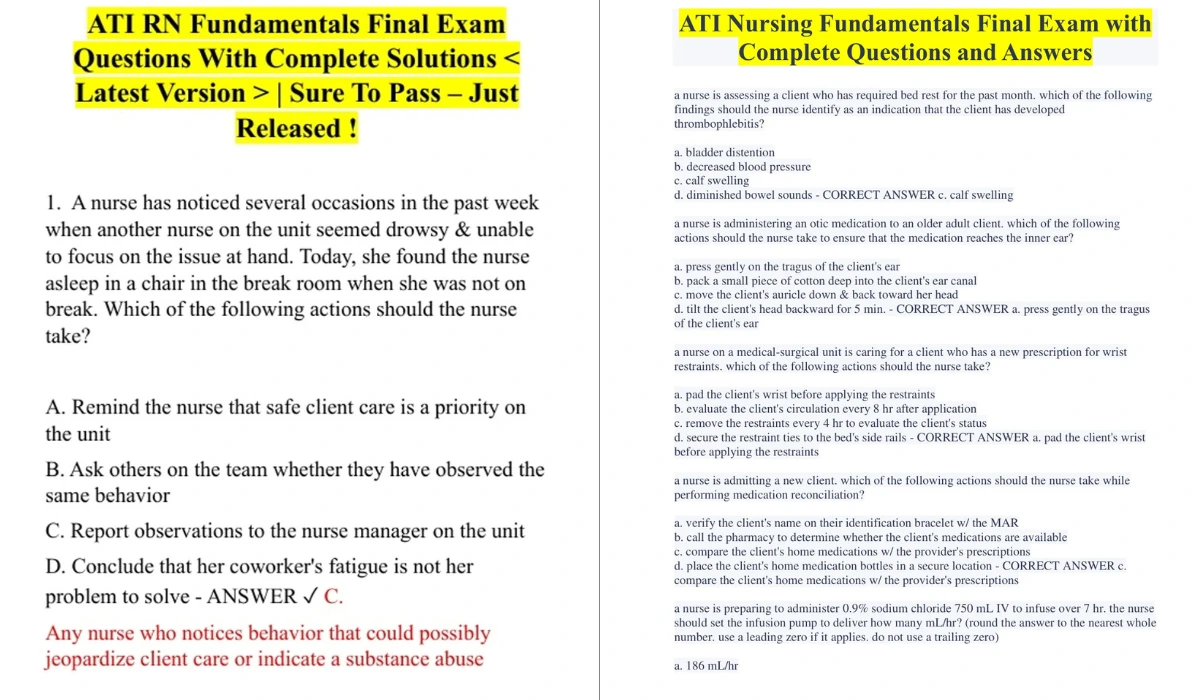
The RN Fundamentals 2016 exam with 70 questions is a standardized assessment created by Assessment Technologies Institute to evaluate nursing students’ mastery of foundational nursing concepts before graduation or licensure. Students typically receive 70 minutes to complete the proctored examination, requiring efficient time management and quick recall of essential nursing knowledge. The exam serves as a comprehensive measure of readiness to provide safe, competent patient care across various clinical settings.
The 2016 version covers five major content domains that form the foundation of nursing practice. These include foundations of practice with healthcare delivery systems and therapeutic communication, basic nursing care addressing medication administration and infection control, psychosocial needs including cultural competency and end-of-life care, and physiological support covering oxygenation, fluid balance, and neurosensory assessments. The exam incorporates multiple question formats including traditional multiple-choice, multiple response items, ordered response sequences, fill-in-the-blank calculations, and hot spot questions identifying anatomical locations.
The ATI system provides detailed feedback through performance reports categorizing achievement into proficiency levels. Level 3 indicates mastery with scores above 90 percent, Level 2 represents satisfactory performance between 70 and 90 percent, and Level 1 signals below basic understanding under 70 percent requiring significant remediation. These levels help nursing programs identify students needing additional support and guide focused study plans addressing specific content weaknesses.
Online practice assessments became valuable study tools allowing students to familiarize themselves with exam format and time constraints before the high-stakes proctored version. Practice exams contain rationales explaining correct and incorrect answers, helping students understand reasoning behind each question and reinforcing critical thinking. Students can access practice exams up to five times per purchase, enabling repeated practice that builds confidence and identifies persistent knowledge gaps.
Effective preparation strategies include systematic review of ATI study modules covering all tested content areas, participation in case studies and simulation experiences, formation of study groups, and utilization of practice questions with careful review of rationales. Students benefit from prioritizing high-yield topics frequently tested such as medication safety, infection prevention, patient safety protocols, and therapeutic communication techniques.
The exam mirrors the NCLEX-RN format, preparing students for licensure examination question styles and content organization. Students should create concept maps connecting related topics, practice NCLEX-style questions daily, and seek instructor clarification on confusing concepts well before the scheduled exam date. This comprehensive preparation approach maximizes retention and understanding of complex nursing principles essential for safe patient care delivery.