
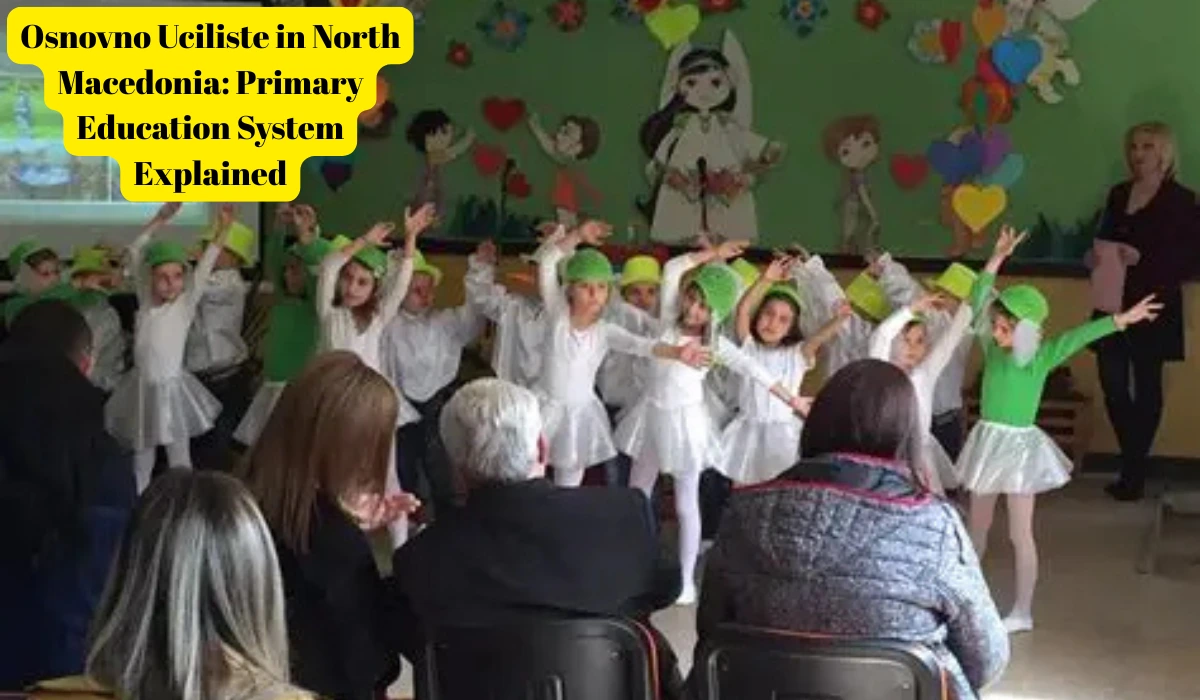
Osnovno uciliste represents the primary school system in North Macedonia, providing compulsory nine-year education for children aged six to fifteen years. According to official education data, the system serves all students with free textbooks and guaranteed transportation for those residing over two kilometers from their school. The structure divides into three educational periods covering grades one through three, grades four through six, and grades seven through nine, with teaching delivered in Macedonian, Albanian, Turkish, Serbian, and Bosnian languages based on community demographics.
The curriculum encompasses compulsory subjects including native language, mathematics, English, art, music, science, society, and physical education in early grades. Students begin computer work in third grade, informatics in sixth grade, and a second foreign language starting in sixth grade. According to the Bureau for Development of Education, chemistry and physics are introduced in eighth grade, while biology begins in seventh grade. Total compulsory subjects range from eight subjects in first and second grades to fourteen or fifteen subjects by ninth grade, depending on language of instruction.
Primary education in North Macedonia follows competence-based curricula aligned with national standards developed through reforms implemented in 2007 and updated in 2021. According to government reports, amendments to the Concept for Primary Education adopted at the end of 2024 returned scientific disciplines including history, geography, biology, physics, and chemistry as separate subjects in grades seven through nine. New curricula will be introduced in stages starting from the 2025/2026 school year and continuing through two subsequent academic years. The Ministry of Education and Science reports these changes address concerns about student achievement in international assessments including PIRLS and TIMSS.
Education authorities indicate that primary schools can be state-run or municipal, with municipalities establishing schools on their territory to accept all children of school age. The government establishes primary schools with resource centers for students with special educational needs or international primary schools. According to the Constitution of North Macedonia, instruction is provided in the official language and any language spoken by at least twenty percent of citizens in a given municipality. Free primary education is guaranteed as accessible to everyone under equal conditions, with private primary schools not officially recognized by educational authorities.
The decentralized management system assigns responsibility for primary and secondary schools to municipalities, except for secondary schools in Skopje which fall under city jurisdiction. According to education statistics, over the last twenty years North Macedonia has implemented several initiatives to improve student achievement, including USAID’s Primary Educational Project from 2006 to 2011 focusing on mathematics and science, UNICEF’s Teacher Education Programme on Early Numeracy and Literacy from 2009 to 2015, and British Council’s 21st Century Schools Programme from 2018 to 2021 targeting critical thinking for students ages ten to fifteen.
Teachers in osnovno uciliste are required to complete at least sixty hours of professional training over three school years, with at least forty hours in accredited programs according to the Law on Teachers and Professional Associates. Assessment occurs through formative and summative methods, with student progress monitored throughout the school year. Upon completion of primary education, students receive a Certificate for Completed Elementary Education and proceed to secondary education, which is also compulsory and free in public institutions. The system aims to develop critical thinking, problem-solving skills, and foundational knowledge necessary for future academic pursuits and responsible citizenship in a democratic society.